Thursday, November 17, 2011

The Churches of Lalibela


Some Ethiopians believe that the 11 rock-hewn churches in Lalibela were created entirely by God, others that King Lalibela was empowered by God to carve them on his own in only 23 years, and then there are the historians who believe that they took close to a century and 40,000 workers to complete.  Any way you look at it, the churches are absolutely remarkable. 

These churches have many similarities to the ones we saw in Tigray, especially the inside design.  All have the typical Axumite arches with supporting pillars, but these churches lacked the paintings on the inside that were very common in Tigray.  However, the churches in Lalibela were much more striking to me, as you could stand on a giant granite precipice and look down at a church that was carved where there used to be only mountain.  Our guide said the churches were carved from the top down on the outside and then from the bottom up on the insides, which makes sense.  The outsides of the churches were smoothed down in most places but on some of the inside walls the marks from hammer and chisel were quite visible and added to how impressive these structures really were.

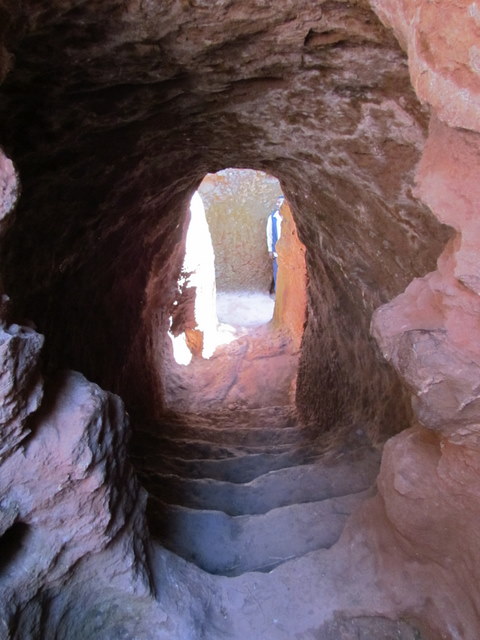
There are two clusters of churches in close proximity to one another and then St. George’s Church stood by itself nearby.  There were tunnels and passageways connecting the churches within the clusters, the longest one being 27 m long.  We had a guide the first day which was instrumental to finding all of the passageways.  He was very informative and gave an enjoyable tour.

This shows the top of the columns and arches typical of the Axumite style seen in all the churches.

I forget the name of this one, but you can see the rock wall on the front left where the church was originally carved out of.  The scaffolding on top is from UNESCO to protect the church from erosion.

St. George Church.  Visually my favorite.  It's an eye-catching cross shape and you can clearly see how it was carved out of the mountain.

St. George Church

Example of one of the tunnels or carved passageways.

I also forget the name of this one, but it was one of the more visually stunning.

Lalibela was a good stop overall.  We had heard warnings from other travelers about being followed for blocks by begging kids, but it wasn’t that bad for us.  It was actually much easier and had fewer hassles than seeing the churches in Tigray, which was a welcome change.

After spending two days seeing the churches we actually parted company for a few days for the first time on the trip.  Anne wanted to go on an overnight hike to the top of the escarpment, but I wasn’t feeling well and wanted some downtime. However, as lovely as Lalibela, was I didn’t want it there.  I ended up changing my flight to Addis Ababa and left two days early where I hung out in the city enjoying good food and good company (Marie, the French woman we befriended was also there), and good internet access where I started looking for jobs in earnest.  I will let Anne talk about her hike:

Looming above Lalibela is a farm-covered escarpment. And by farm-covered I mean they plowed and harvested areas that could almost be called cliffs. It was insane. The hike up to the lovely round huts of the community camp was easy and straight forward until the very end. The guides think that white folk are crazy and enjoy scrambling up near-vertical rock beds in a crack in the cliff. I’m pleased to report that even though the area fell profoundly into the “steep slippery things” category, I wasn’t scared and just climbed up. The extraneous city boy guide I was required to take was freaked out. The next day we took the easy route down.


It was nice to be out walking after days in the car. It was nice to sit and enjoy views while just listening to music and reading. And it was nice to try to burst a conceited Ethiopian guy’s bubble about how easy his life will be if he wins the green card lottery for the States. I know, it sounds cruel, but he just had no idea about how good he had it as a wealthy Ethiopian (who looked down on the “peasants” he worked with everyday as a guide) compared to what it would be like as a poor immigrant in the U.S. who would likely be the victim of the same discrimination he tended to dish out. Seriously, the U.S. needs to start an ad campaign that basically says “We aren’t all movie stars.” and shows people being denied medical care or living on the streets.
But I digress. Hike was nice. Lalibela is pretty. Ethiopia definitely grew on me.

Sunday, November 13, 2011

The Danakillers


 For the umpteenth time that day one of the four-wheel drive cars in our caravan was bogged down in the mud and sand. Our vehicle was forced to stop behind it and was soon stuck as well. Night had fallen and we stayed in our car as it started to rain, bright bolts of lightning piercing the vast openness that surrounded us. Our journey through one of the hottest, driest deserts on Earth was thrown off course by rain storms. Go figure.

In northeastern Ethiopia lies the Danakil Depression, a baking hot desert where temperatures frequently go above 120 degrees Fahrenheit. It’s the home of the aggressive and resourceful Afar people, ancient salt mines, and amazing geological formations. To visit the area you have to join a caravan of cars. Going alone would be suicide. Not only do cars frequently encounter problems on the rough tracks that serve as roads leaving them stranded in the oppressive heat, the area is close to Eritrea. Eritrea won its independence from Ethiopia in 1993 but fighters still sometimes cross the border and four years ago kidnapped a group of tourists. We joined a massive budget tour group of 23 travelers going in seven cars.

The tour company was recommended on the Lonely Planet website so a Belgian couple organized the trip, and we decided to join up with them. We exchanged a few emails and short phone calls with the company before arriving in Mekele but didn’t know much about them. At about 9 pm our first night in the departure town, a skinny young Ethiopian woman knocked on our door. Clad in tight jeans and a sparkling t-shirt, she looked like she had just come from a celebration. Abeba was our company representative. The very friendly woman hung out in our room, told us the itinerary, and then sleepily wandered off. She had returned from a different excursion to the Depression earlier that day.

After our brief interactions with Abeba and two ten-minute phone calls with the tour operator we never actually met, they decided they liked us and assigned us to the best car in the caravan. We were joined by Marie, a lovely French woman we met in the Simen Mountains and convinced to join us, and Peter, a biker from Australia. With his deeply tanned, weathered skin and his messy white hair and beard, Peter exuded “traveler.” Within a day of meeting him we had heard his favorite travel stories multiple times, were convinced of the quality of his BMW motorcycle, and knew that after almost three years on the road, he needed to head home. What he kept hidden for at least the first day was his innate ability to lead a group and solve a problem all with good humor and precision.

The first day of our excursion went without much trouble. We left almost two hours late, which means “on time” for most of this continent, and arrived at our lunch spot around 4 pm. The road was good quality gravel, and we got to the campsite shortly after dark. It was unclear where our band of 34 people would sleep until villagers started walking up carrying bed frames made of wooden poles and woven mesh. The beds were lined up outside next to the array of dilapidated stick and mat huts that served as the village. Sleeping inside would have been too hot. Only the strong breeze made the temperature bearable. For toilets we were sent to the ditch next to the site. In the wide open desert, privacy was impossible as we contributed to a public health nightmare. No one in the village had pit toilets and piles of excrement dotted the landscape. It’s still unclear to me if we helped  the community by paying exorbitant amounts to rent their bed, or led to their ultimate downfall by introducing more diseases to the area.

On our second day we piled into the cars to head to Irta’ale, an active volcano. It was supposed to take about six hours to reach the base of the volcano. An hour into the drive over dried mud and sand we came across some wet patches. Six of the seven cars drove around the mud. The seventh, after watching the others circumvent the area, drove through and was immediately stuck. We waited in the 100 degree heat for half an hour while they pulled him out and were off again. Twenty minutes later we turned around. Communication not being the strong suit of any of our intrepid tour leaders or drivers, we can only assume the way was deemed impassable. As were the next three routes we tried. Finally, about mid-day, the drivers and the local Afar guide decided that driving the normal route on the rain-soaked mudflats wasn’t going to work. Instead, we drove through a sandy plain dotted with shrubs and camels.

We thought we were safely on our way until we reached the first river. In this case I use the term river loosely. It was a thin, shallow trickle of water through mud. Instead of getting out of the car to see the best route through, the first car plunged ahead and was stuck in foot deep mud. The next car drove easily around the beleaguered behemoth and tried to pull it from the mud. It got stuck in the process, as did the third car. Peter, who was used to driving around the Outback of Australia, tried to communicate via our driver, who spoke a bit of English, different ways of getting the vehicle out. He was largely ignored, and it took over two hours to move on.

The afternoon was riddled with small incidents. One car was stuck, then the next, then another. It was nearing dark when we decided to drive on a mining company road instead of plowing through the nothingness. It was pitch black when we finally extracted the cars from unexpected sand dunes and dramatically changed course. First we were told that we were lost and had taken the wrong turn. Most of the tourists were flabbergasted by the incompetency. Didn’t we ask for directions an hour before? Didn’t we have a local guide with us to prevent this from happening? Then, the story changed. According to Abeba, the Afar police man we were required to have accompany us had changed his mind. Originally he said we could skip the village where we had to buy another permit to visit the volcano and just return to pay in the morning. Now we had to backtrack to the village.

The caravan plunged ahead into the darkness. As we swerved around clumps of bushes and piles of sand, the wind started picking up. Soon, it was impossible to see around the vehicle and the other cars became vague lights in the distance. We were caught in a sandstorm. In truth, we felt lucky. The air conditioning worked in our car and all of the windows closed. One of the other cars didn’t have such luck. As we attempted to drive through the storm, unable to see out of the car, we envisioned their car filling with dirt. Our pity subsided when the most of the cars were far ahead, we were stuck in the sand behind one of the less competent drivers, and it started to rain. The lightning bolts were so bright and seemed so close, I was certain that our metal car sticking out in the empty desert would be like a lightning rod.

In our exhausted frenzy we started to devise a plan – who would sleep where, what food and water we had available in case the others didn’t come back for us. When the rain started, the wind died down, and we could see a ways into the distance. A single blue light was moving toward us. At this point our driver piped up. “I don’t want to scare you, but the Afar people say that devils appear in the desert at night carrying lights to confuse you. Not that I’m trying to scare you.” Thinking that a devil was better than nothing, we took out a headlamp and tried to flash S.O.S. into the distance. It was unclear if the other light flashed back, but by that point the rain had slowed and we decided to assess the situation on our own, or so we thought. We were quickly reminded of one of the cardinal traits of rural Africa: people materialize out of nothingness.
With the help of random village men and children, we quickly extracted our car only for the other car to be mired in an easily avoidable puddle for about an hour. The “devil” in the distance turned out to be the nice French man coming back to rescue us and to tell us that we had reached our destination for the night. After 14 hours of driving we were to hole up in another tiny village with mats laid out under random structures. One of the cars was now inoperable and our car of five became a cheery car for eight.
In the morning, we tried once more to head to the volcano. We followed a suggested route only to reach another river. As we got out of the cars to consider where to cross, water began surging down the river bed. All of the rain from the night before both in the depression and in the mountains was creating a flash flood. We quickly moved the cars and headed back to the village. Then the arguments began.

Some drivers wanted to stop trying to get to the volcano. Word filtered out that we also couldn’t get back to the original camp because of the floods. Our crowd of tourists began to panic. What if we ran out of water? They didn’t pack enough water, one group cried. Some went to count the number of water bottles in each car. Jeanette rolled her eyes. They were panicking about water when we were surrounded by rivers and had plenty of water treatment drops between us. They were worried about food when, if we got to dire straits, we could easily kill one of the innumerable camels. It was all a bit silly, really. People probably wouldn’t have panicked as much, though, if the communication was better. None of us understood the heated conversations in Amharic between Abeba, the guides, and the locals. All we knew was that after about an hour, we decided to try a different route.

This time, it worked. Smooth sailing. Okay, smooth sailing until the typical problem car was stuck in the mud again only an hour from the volcano base camp. After about an hour, we decided to eat lunch. More time passed. The Ethiopians gave up; they had tried nearly everything to pull the car out. Finally, Peter stepped up to the plate again. He directed all of us to start grabbing the innumerable volcanic rocks that littered the landscape. He and a few others started digging the mud out from under the tires and shoving rocks into their place. In twenty minutes we had a mini-rock highway and the car chugged, chugged, and was out. An hour later after a bumpy pumice road, we were there.

The hike up took about three hours. Even after dark the air was so hot that we all dripped sweat. We arrived at the peak and looked beyond the small, empty rock huts to a red glow in the distance. Under the light of the full moon we descended into a rock crater and within minutes were standing above a roiling, exploding, ever-changing pool of magma. About 60 meters below us was liquid rock – the mantel of the earth exposed. Depending on the wind direction, we were blasted with heat and sulfur, but it was hard to look away. The lava quickly cooled on the surface turning black and shiny. Red cracks cut through the surface exposing the lava below. Slowly, bits would sink under, red pools would form, and the lava would spurt into the air. Some bits would land like rocks on the fluctuating black surface and skitter across, others would ooze over and pull the blackness back down into the red. It constantly changed, constantly kept us interested. On the far side of the rim on which we stood, bits of rock fell into the pool below. We quickly stepped back, conscious of the cracks on our side of the rim as well. It was one of the most exhilarating and spectacular moments of my life. We watched for hours and celebrated the start of 11.11.11 with the small group who remained into the night.
When we finally decided to go to sleep, we walked back to the group of huts on the ridge. We weren’t allowed to put our mats in the huts or even the flattened walled off areas near the huts. The guide said that someone lived there, but, given that the place was deserted, we figure that the company would have had to pay someone if we were seen there. We bedded down on a rocky patch between a small pile of rubbish and an old animal pen. At dawn, we woke up the guide and returned to the pool. The lava had calmed down, but the morning light made it seem like the lava pool was much closer than the night before. We headed down the volcano and had a rather uneventful trip back to the original sleeping spot. It was a nice change.


Our final day in the Danakil included a visit to Dallol, the second lowest spot on the continent.  At first it seemed like nothing more than a flooded salt pan. After a few kilometers of driving we started climbing up a pile of oddly textured brown salt rocks. Then, the salt began transforming. It became strange, round coffee tables that looked like sawed off logs. Then the white tables shrank into toadstools. We were bemused by the formations until we turned a corner and were dazzled. The salt formed fountains of neon yellow sulfur. The surreal formations glowed with the sulfur. Mounds spitting boiling water were yellow, pools were lime green, and plains of bumpy salt were brick red. The small lake felt Martian-like.


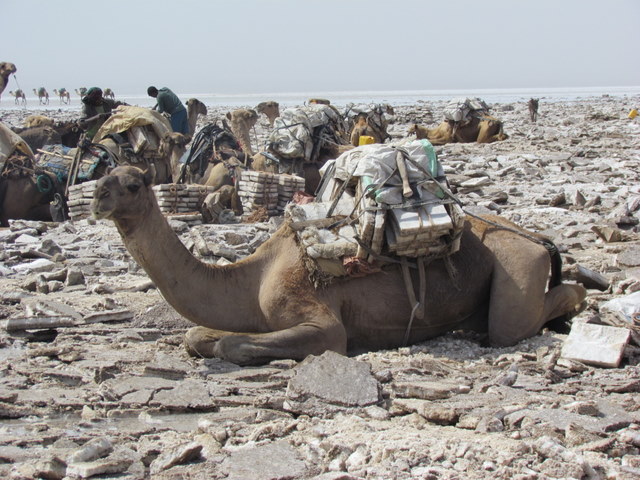
After visiting the lake we went to see the salt caravans. Dozens of camels waited to be loaded with salt bricks. The Afar men chopped large, flat chunks of salt from the salt plain, just as they had for centuries. Salt formed so quickly on the plain that even camel droppings were quickly covered. Using angled chisels the Afar chopped the salt into perfect rectangular bricks. Each camel carried four stacks of six bricks for six days to Mekele. Each brick sold for 25 birr each, or about $1.50. Rumor has it a company is trying to build a conveyor belt to transport the salt and put it into trucks. It would destroy a way of life that predates most modern cultures.


At long last, our trip to the Danakil Depression was over. Many different versions of “what went wrong” floated about the group, but in the end it was a success. We saw the volcano, we saw the salt flats, and, in the end, we even had a couple extra bottles of water.
 

Monday, November 7, 2011

Ethiopia - The Good Stuff

(Long with lots of photos. Enjoy!)

The food: it’s cheap and delicious.  Plus there are huge portions so we can usually split a meal and both eat for less than $2.  The only downside is that Ethiopian food seems to give me horrendous gas so we have to limit our consumption of injera and lentils or chickpeas to one meal a day.  Many menus in tourist areas have a pasta or pizza option and tend to be fairly tasty, thanks to a large Italian influence even though they tried to occupy the country several times in the past.

Coffee: Readily available macchiatos for less than 50 cents that don’t upset Anne’s stomach. I often opt for the 60 cent cappuccinos. 

National Pride: it’s huge.  Ethiopia is the only country in Africa that was not colonized and people are very proud of their unique heritage.  There were some rough times and really awful battles against Italian occupation attempts, but Ethiopians prevailed.

Internal flights: they’re cheap!  Ethiopian Airlines has some fantastically cheap internal flights and some really bad roads so we splurged and have saved ourselves days of travel and countless frustrations.  Plus, the guy who worked at the airlines office in Addis Ababa and helped us arrange everything is one of the nicest, most helpful, and patient employees of any company that I have ever encountered.

Lodging: it’s not bad.  Although prices have at least doubled since the printing of our 2009 guidebook, we can still usually find a place for less than $15 a night.  We have splurged a few nights and spent around $30, which was nice.  I have only woken up twice with flea bites and one of those was from the rented sleeping pads from the Simen Mountains.   Our huge splurge was two nights ago where we spent one night in a rustic, beautiful, and very comfortable Italian lodge at $60 per night PLUS $8 each for dinner.  It was quite extravagant but our sanity needed it to get rid of some of our traveling frustrations.

Old stuff: there is lots of it.  Temples and rock-hewn churches and castles galore from as early as 6th century BC.
Some of the information we have learned from our guides is contradictory to what we’ve learned from other guides or our guidebook, and history here is often deeply infused with legend so it’s hard to know what is real versus what is myth.  Plus, we’ve often picked up on times when our guides just sort of make-up answers to our questions rather than admitting that they don’t know, so the history below is a mix of information from our guidebook and what we’ve heard from guides and should be taken with a grain of salt.

National Museum in Addis Ababa: We saw Lucy! Okay, we saw a really good replica of Lucy as the original is currently on display in New York.  This infamous Australopithecus afarensis skeleton was, at the time of discovery in 1974, the oldest and most complete hominid ever found and showed that A. afarensis was bipedal as far back as 3.2 million years ago.  This floor of the museum had a really good display of tooth fragments, skulls, and bones found all over Ethiopia showing the evolutionary changes leading up to Homo sapiens.  It was even more impressive when I thought about how all of these bones were found RIGHT HERE in Ethiopia, many from the Afar region which we will visit later in this trip. In addition to the excellent display on human evolution, the museum boasted a modest but beautiful collection of modern Ethiopian paintings.

Gonder: Although this former capital city has many different spellings, it is not actually pronounced “Gone-door” like in the Lord of the Rings, as I had been saying.  Emperor Fasiladas established Gonder as his capital in 1636 and built a huge castle and palace for himself.  His son and grandson followed him to power and even Empress Mentewab who married into the royal family ruled for 25 years.  They all built more additions inside this Royal Enclosure (a UNESCO World Heritage Site) which includes palaces, castles, a sauna, a library, a banquet hall, horse stables, lion cages (seriously, it proved that they even had domination over the king of the jungle), archives, and a kitchen. Some of the buildings were in pretty good shape although many were damaged by Sudanese Dervishes, invading Muslims, in the 19th century, and British bombings from early World War II against the Italian occupation.  Considering most of these were built in the 15th and 16th centuries they were in remarkable shape.
Main Palace at Gondor

presence
Ceiling in different palace -- each king built one to they'd have an everlasting 


Old chapel in Empress' compound
Paintings in the oldest surviving church in Gondor

Simen Mountains: When you talk about steep cliffs, towering views, and undulating plateaus it is hard to rival the Grand Canyon, but I have to admit that views from the Simen Mountains did just this.  We did a 4-day hike with a scout who spoke very little English, a mule, and a muleteer who spoke virtually no English.  The scout was required and he came armed with a rifle although I’m still unsure as to why.  He was good at warding off the begging children and two really, really mean dogs.  The office recommended a mule and muleteer due to the elevation and since we were renting gear (tent, sleeping pads, and cooking gear) we thought it wise to get the mule as they did not provide quality, lightweight backpacking equipment.  The climax of the hike was out to Imet Gogo, a precarious cliff surrounded by absolutely stunning views at 3926m/12881ft.  We had no problems with the elevation, likely due to our recent Kili hike and the fact that a mule was carrying most of our gear.  It was cold at night but perfect hiking weather during the day.  Our visit here followed a few rainy months so it was incredibly green and lush.  One thing that struck us both was how covered the landscape was with farm plots.  It was astonishing to see crops growing on plateaus at the tops of vertical cliffs in every direction.  Despite the annoying kids on the way here, this view was worth every ounce of frustration.

Farmland covered everything

This doesn't come close to capturing it

Our rock star scout, Tafil

Gich village

Barely adequate photo from Imet Gogo

Cool plant
Sunrise -- we had to wake early to hike 23 km to get the bus to Gondor that day. We went super slow because Anne was sick. Icky.

Along the way we also stopped at a local woman’s house to see how traditional coffee is prepared. Using an old USA food aid can she washed unroasted coffee beans then roasted them on a flattened metal plate over the fire. She crushed the beans with a heavy mortar and pestle then brewed the coffee. The subtle flavor lacked the bitter aftertaste of coffee that we’re used to and for once didn’t even need sugar. 
Fatima pounding coffee

Fatima's house where she slept on a loft above the livestock

Gelda Baboon, not actually related to other baboons and much friendlier


Aksum: The two biggest tourist attractions here are the giant stelae erected over several tombs and the Ark of the Covenant.  A stelae is a massive, narrow rock planted upright in the ground. Some are carved, others are just rock, depending on whose grave they represented. Aksum was a very important center for trade beginning around 1 AD and flourished for four or five centuries and was presumably the home of the Queen of Sheba in the 10th century BC.

The Northern Stelae Field is right on the outskirts of town.  I would have found it more impressive if not for the buildings surrounding it and the giant crane holding one of the stelae up. The modern setting really takes away from the aesthetic appeal of the ancient structures.  An enormous 10 room mausoleum is beneath a fallen 33-meter-long stelae.  Many other tombs were also accessible, built in a similar style with a room in the middle for the coffin and then surrounding rooms to hold numerous treasures.  Most of the tombs were robbed well before archeologists entered them.   The stelae are up to 33m high (the largest is lying in pieces as mentioned above) and were likely erected to commemorate the burial of someone important, however, due to the grave robbers, it is unknown who was buried in many of the tombs.  The stelae are one giant piece of granite taken from a quarry 5 km away likely with a combination of elephant power, giant wheels , and fierce determination.  They were quarried, carried, carved, and erected sometime between the 3rd and 5th centuries AD.


The largest stelae, which fell hundreds of years ago

Tomb underneath the Great Stelae

Rome Stelae, broken in three by the Italians to steal it and move it to Rome. They just got it back recently.

The One with the Crane

Ethiopians firmly believe that the Ark of the Covenant is held within a chapel no tourist can get near in the St. Mary of Zion Churches complex.  This chapel is guarded by one man who never leaves the building and is in his year of duty.  Our guide said he will pick his successor when he starts getting old, but if he dies suddenly a church council will choose the next guardian monk.  Legend has it than Menelik I, son of the Queen of Sheba and King Solomon, went to visit his father in Jerusalem and absconded with the Ark back to Ethiopia.  It is rumored to have been housed in several places in Aksum, including the Queen of Sheba’s Palace, before finding its current home in a building where only one man every 20+ years sees it.  A skeptic could say this is somewhat dubious but Ethiopians firmly believe it and that is what counts.  Besides, the Indiana Jones-like curiously of this ancient relic was enough for me to pay the steep entry fee to see the building.
Chapel housing the Ark

Illustrated prayer book


We also saw the ruins of the Queen of Sheba’s Palace, called Dungur. Most archaeologists actually think the ruins are from 10th century AD, well after Queen of Sheba’s reign. Most Ethiopians believe otherwise. A recent excavation showed that another building was built before the top layer of ruins and that could have been the Queen’s true palace. Regardless of the exact history, the ground floor of this massive palace was well preserved and interesting to walk through.  A platform was erected just outside the palace that affords visitors a bird’s eye view of the area.
Little stelae field near the Queen's Palace


The King of Ezana’s Inscription is a Rosetta stone-like giant monolith containing inscriptions in Greek, Ga’ez (an unspoken language that predates Amharic), and Sabaean from around 350 AD.  The inscription speaks of King Ezana’s military conquests and contains a curse upon he who dares to move it.  Our guide said this tablet was found by three farmers lying on its side and was re-erected exactly in that same spot.


Yeha: This giant sandstone structure is dated between the 5th to 8th centuries BC making it the oldest I have ever laid my eyes upon.  The masonry was absolutely impressive with giant “bricks” laid together so smoothly and without mortar that you still can’t slide anything between them.  Our guide said this was likely a temple built for the God of the Moon, the same god worshipped by the ancient kings of Axum before the incursion of Christianity.  There were archeologists at work here restoring the structure so unfortunately there was some hideous scaffolding all over the inside but was fascinating to see anyway.
Ancient Temple of Yeha

Adwa Mountains


Rock-Hewn Churches of Tigray: (It’s Anne writing now. Before it was Jeanette.) Tigray looks like a dusty area of land covered in grain fields with massive red cliffs sprouting up out of nowhere. The chunks of primarily sandstone mountains provided spectacular views and inspiring places to carve churches. Once again it’s unclear if the 120 churches were carved by saints and kings during the 4th century as all of the guides profess or by others between the 9th and 15th centuries. Either way, they were impressive. The architects carved away enough stone by hand to create free-standing pillars, geometric designs on the ceilings, and cavernous spaces for prayer and congregation. The churches are still used to this day and have portions curtained off to protect the Holy of Holies, a replica of the Ark of the Covenant. Most of the churches are fitted up with small but ornate chandeliers that come straight out of the 1980s and have wires crisscrossing the ceiling along with other curtains.    

Many of the church walls had murals of varying ages and conditions depicting Jesus, Mary, a cadre of Ethiopian saints, and other orthodox imagery. My favorite was a picture of the Holy Trinity depicted as three different colored orbs with faces. Typically the Trinity is drawn as three old white men. Our guide said that many of the original murals were destroyed by an evil Jewish queen who tried to burn down all of the churches. Though the physical evidence doesn’t support this belief, as previously mentioned, legend is fact in Ethiopia.

Visiting the churches isn’t exactly straight forward. To get to Maryam Korkor and Daniel Korkor churches we climbed up a steep, rocky crevice in the cliff then over sandstone to the churches carved on the top of the mountain. It wasn’t very strenuous. But to get from those churches to Abuna Yemata Guh, the nicest church we saw, we got off the beaten path, if you will. By which I mean we followed our guide down six foot drops into rock crevices to a river bed. In the process of Jeanette and the guide patiently helping me into areas that I simply shouldn’t be going, my arm rubbed against some random plant and – you guessed it – I got a really itchy rash. Needless to say, despite the spectacular views, I was not in a good mood by the time we got to the base of the hike to the actual church, where most tourists start.

Despite this, I hauled myself up the mountain to the point where we had to take off our shoes and climb the sheer rock face barefoot. For any of you who have ever met me or even followed this blog, you know this falls into my category of Really Stupid Things That Only Crazy People Do So Don’t Make Me. So of course the guides, a contingent of scouts who had decided to join our trek, and Jeanette coaxed me up. The cliff had a series of hand and toeholds worn into it, but they still had to tell me exactly where to put each part of my body. Then, we climbed up not quite so sheer cliffs over massive drops and walked across a ledge over nothingness to the church. Actually, I’m over my fear of ledges, so that wasn’t so bad. Luckily, the church was actually worth it. The paintings were bold, simplified figures and the colors still shone magnificently. Our guide commandeered our camera and took about 100 photos. I made it back down the same route, too, in a slight drizzle. Still think it was stupid, though.       
View of Tigray

Rock-hewn pillars


Happy apostle in hard to get to church

Lots of sort of happy apostles

Not-so-scary ledge

Do you see why climbing that was so stupid? I mean seriously, who came up with that idea?

Geometric designs carved into ceiling

Paintings covered most surfaces of churches

Sunday, November 6, 2011

Ethiopia -- You've got to be kidding me


Warning: Ethiopia has turned out to be much more difficult to travel in as a white person than expected and this blog entry contains a therapeutic release of some of the accumulated bitterness resulting from said difficulties.

Did you know that white people are actually vending machines? Yeah, it’s this magical transformation that happens as soon as you enter Ethiopia. Suddenly, every child and even some older teens greet you with “Hello, money. Hello, pen. Hello, plastic (bottle).” The begging is constant, and it’s not like you can just say no. They just keep repeating themselves and following you everywhere. Sometimes I think the kids actually think “hello pen” is how you say “hello”.  You’re mobbed by kids who want something from you. Of course, Jeanette and I are broken vending machines. We refuse to dispense. 

This does not deter the kids from surrounding us and repeating themselves, though.  When we walk anywhere in smaller towns, including our hike in the Simen Mountains, there is a chorus of “hello, hello, hello, hello, hello, hello, hello, hello,..”.  Some kids will shout this one word indefinitely from across a valley so eventually you say hello back or wave and then you are returned with another 5 minute chorus of “hello, hello, hello, hello, hello, hello, hello, hello,…”.  This is much better than the begging though.

When hiking in the Simen Mountains we encountered kids who were selling little baskets, woven hats, and long ropes that work as slingshots. We debated whether or not buying them would be helpful or just encourage them not to go to school. We were still on the fence about the issue when we walked to a beautiful view point where a group of kids were peddling their trinkets. After saying no and taking a few photos of the mountains the kids shouted “Picture! Picture!” Unsuspectingly I assumed they were like the kids in every other country we’ve been through so far and just wanted to see themselves in the little screen. I shot the photos then showed them. Immediately one of the boys pointed to himself and then the others saying “One. One. One.” I thought he meant they each wanted individual photos, to which I said no, but he quickly clarified saying they wanted one birr each for being in a photo. In a photo I didn’t want. Luckily, the word “delete” is the same in English and Amharic and the scout who was required to accompany us knew that we got rid of the unwanted photos and told the kids.  Then the kids started throwing rocks at him. Seriously. Later on in the walk, kids started throwing rocks at us, too, with the slingshots we declined to buy. It sucked.

Typically Jeanette is the jaded one out of us and I try to find the positive, so here’s my futile attempt. At least interacting with all of the really, really, REALLY annoying children was like a hammer whacking into each of our biological clocks. Neither of us wants kids and boy did this help make sure that as we each approach the magical age of 35 when every woman starts hankering for a baby, neither of us will. Also, we don’t have the added weight of their small baskets in our packs. (That said, we love all of our family and friends’ children and love watching them grow up.) 

I’m not sure if it’s just because we’ve been traveling for so long and our tolerance levels are low or because I’m running a low-grade fever or what, but I’ve never thought I could be so annoyed at an entire population. Because it’s not as if it’s only the kids who want something from us, it’s the adults, too.

Before heading to the Simen Mountains we spent a few days in Addis Ababa, the capital city. On the second day we were walking around looking for the telecommunications office to buy a SIM card for our phone and got horribly lost. We asked a man on the street who greeted us in English. He said it was close by and he would show us. “How nice!” I thought. As I got the SIM card, he chatted with Jeanette. Then he followed us to the airline office where we were sorting out our low-cost internal flights. Jeanette kept saying things like, “We can do all of this on our own, if you have to go somewhere, feel free.” He kept saying, no, no, as if he enjoyed hanging out with us. He showed us to the museum, at which point Jeanette said, very politely, go away. She even offered him 20 birr to help him buy a new phone. He scoffed at her saying that as our guide he was owed much more. Our what??? We never asked him to be our guide; we just wanted directions and thought he just wanted to hang out. We were completely scammed and spent 10 minutes explaining to him that we shouldn’t have to pay for a service we did not ask for or even want and that if he was going to finish his tourism degree and work with Western cultures as he wanted to and claimed to be good at, that he needs to understand Western cultures operate in a very straightforward and upfront manner - no sidling up to people, following them around, and then demanding money. 

I won’t even get into it about visiting the rock-hewn churches of Tigray. Suffice it to say, everybody and their brother wanted a piece of the pie. We were transformed from vending machines to walking ATMs. We even had to a pay a guy who followed us up the cliff to watch our shoes outside of a church on the top of an isolated mountain so the crazy monks didn’t steal them, or so we were told. Our guide/driver even got angry with us for not buying old church icons for $50 each to support a church’s restoration. How could we not want them? Not only are we white tourists, who always buy these things, but also, the priest at the church showed us a book and said we were good people and predicted we would soon have children. (If only he knew, right? Was he predicting another immaculate conception?) How could we not buy them? Oy vey.

Suffice it to say that while slightly being taken advantage of and seen as a target in the rest of Africa was a bit tiresome, this blows my mind. I really, really wanted to like Ethiopia and while it has incredible landscapes and history, I’m so over this. The begging is intense in a way I’ve never experienced before even though the people honestly seem to have more money than in many other places we’ve been. The land is producing plenty of grain.  Families have numerous cattle and countless sheep and goats. My old village in Tanzania was home to maybe ten cows, total.

Our tour guide for Tigray says that the country was destroyed by tourists who just hand out things to children. He has a point, but at the same time, parents have the responsibility of teaching children that mobbing white people and begging isn’t a great way to make a living. But it’s a hard thing to teach when you yourself see white people as a walking ATM as well.  We are doing our best to right the wrongs of other travelers by not handing out anything, but I doubt we've made any impression on the kids.

Sorry to sound so bitter. Not all of the people here are horrible; some are truly friendly. But for the most part, neither of us is sure we could actually recommend coming here except on a highly organized tour wherein you never have to interact with money and thus only have to deal with begging kids and not being fleeced for everything else. The following post will highlight what we’ve been doing since getting to Ethiopia. It’s an interesting place, but it sure is exhausting. I can’t wait to get back to east Africa! (Also, since writing this we’ve landed in Mekele, the first town we’ve been to where pretty much everyone ignores us. It’s FABULOUS.)

This is Jeanette here.  I take back everything bad I said about the touts and annoyances in Tanzania.  It was nothing compared to this, nothing at all.  This is exhausting and frustrating and wearing me out.  I am completely on the defensive now, not like I thought I was in Tanzania.  It’s awful to not take people at face value but we just can’t or we’ll be taken for every last dime we have.  A few other travelers have said that it’s much worse in India so I don’t know how I’m going to survive that some day.  Maybe it will help going right at the begging of a trip rather than several months in when you’re already somewhat worn down.